Welcome to Portuguese Roots. Whether you are taking your first step into family history or chasing an ancestor back to a village in the Minho, a parish in the Azores, or a town in the Alentejo, you are in good company: Portugal kept excellent records, an enormous share of them are digitised and free, and a patient researcher can often trace a family well back into the 1700s and beyond. And uniquely among the sites in our family, Portuguese ancestry can lead somewhere remarkable—to Portuguese (and therefore EU) citizenship. Here is how the site is organised and where to begin.
What makes Portuguese genealogy distinctive
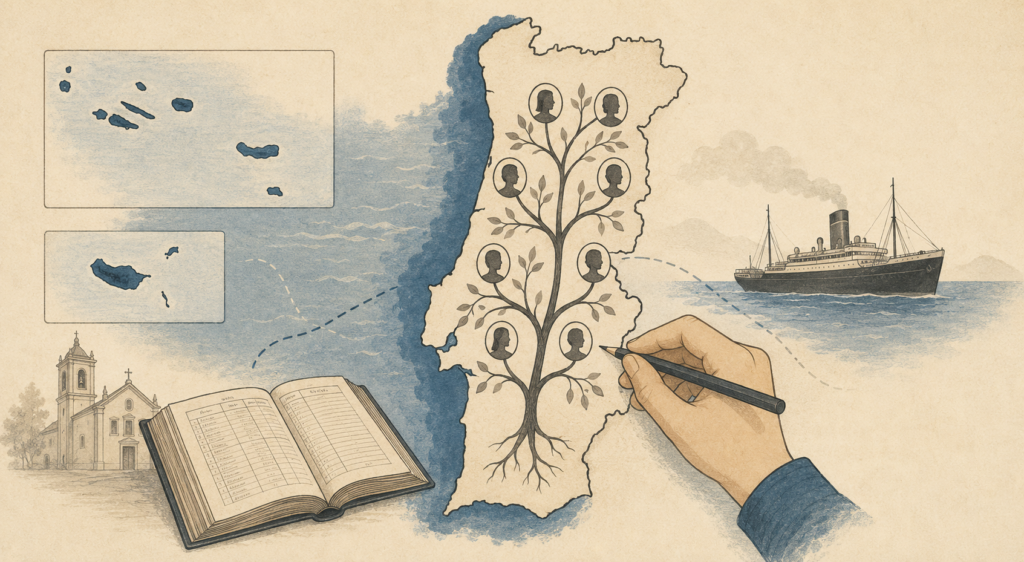
Three things shape Portuguese research. First, the records: Portugal introduced compulsory civil registration in 1911, and before that the Catholic Church’s parish registers reach back centuries—and much of it is free online through FamilySearch and the district archives. Second, the islands: the Azores and Madeira sent huge numbers of emigrants abroad, and island research has its own character. Third—and unusually—citizenship: unlike many countries, Portugal offers genuine citizenship by descent to the children and grandchildren of Portuguese citizens, a life-changing possibility we cover honestly and with the current 2026 rules.
Not sure where to start with your Portuguese ancestry?
Get the Portuguese Genealogy Quick-Start Checklist — a 5-step path to your first real ancestor record, plus the two-surname naming system that trips up almost every beginner.
New to Portuguese genealogy? Begin the right way.
Portugal keeps remarkably deep records — centuries of Catholic parish books and, from 1911, civil registration — much of it free on FamilySearch. This is the path from “my family came from Portugal, the Azores, or Madeira” to a documented, sourced tree.
Read the Step-by-Step Guide →Not sure where to start with your Portuguese ancestry?
Get the Portuguese Genealogy Quick-Start Checklist — a 5-step path to your first real ancestor record, plus the two-surname naming system that trips up almost every beginner.
Portuguese ancestry can be a real path to an EU passport.
Portugal is one of the more welcoming countries for citizenship by descent — routes can run through a parent, a grandparent, and in some cases further back. The rules do change, so the goal here is to figure out exactly which route fits your family before you invest in the paperwork.
Find Your Citizenship Route →
Go straight to the sources that build a Portuguese tree.
Portugal’s Catholic parish books reach back centuries, and much of the collection is digitized and free. Master these core record sets — and the archives that hold them — to trace a line back well into the 1700s.
Browse the Records Hub →
What your Portuguese surname reveals about your family.
Portuguese surnames come from patron saints, places, and old patronymics — and the two-surname system means your family name carries both parents’ lines. Here’s how to read what yours is telling you.
Explore Surname Origins →How your family left Portugal — and where they landed.
From the Azores to New England, from Madeira to Hawaii, from the mainland to Brazil — understanding the emigration wave your family rode is often the key to jumping the Atlantic in your research.
Read the Diaspora Story →Confirm your Portuguese ancestry with the right DNA test.
Iberian DNA overlaps with Spanish and broader Mediterranean roots, so ethnicity percentages only take you so far. The real value is in matches — and the tight, well-documented families of the Azores and Madeira make matching especially powerful.
Compare the Best DNA Tests →Walk the ground your Portuguese family came from.
A heritage trip hits differently when you know the exact freguesia, the parish church, and the village your family left. Plan a journey built around your own research — mainland, Azores, or Madeira.
Plan Your Heritage Trip →