
The obstacle that stops many people tracing Portuguese ancestry before the modern era is the records themselves: old handwriting, unfamiliar spellings, and—in the earliest registers—Latin. It is a smaller barrier than it looks. Portuguese records are largely formulaic, so you are not translating free prose but recognising a fixed set of words in a predictable structure. Learn a few dozen terms and the shape of each record, and you can read most of what you will meet. Here is how.
The handwriting
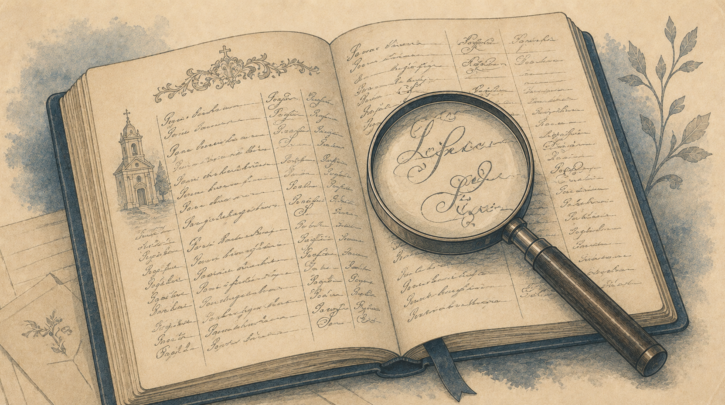
Older Portuguese records—especially the parish registers of the 1600s, 1700s and 1800s—are written in older styles of hand that take some acclimatisation. Letters are formed differently from modern writing, abbreviations are common, and a few letters are easily confused at first. But the hand becomes familiar with practice, and—crucially—because the records are formulaic, context tells you what a word should be before you can fully read it: after a date in a baptism comes the child’s name, then the parents, then the godparents. Reading in context, and comparing the same word or name across several entries, is the single most useful skill.
Not sure where to start with your Portuguese ancestry?
Get the Portuguese Genealogy Quick-Start Checklist — a 5-step path to your first real ancestor record, plus the two-surname naming system that trips up almost every beginner.
Old spelling and orthography
Portuguese spelling was reformed in the twentieth century (notably in 1911 and 1945), so older records use archaic orthography that can briefly confuse. You will meet forms such as Manoel for Manuel, older uses of letters and accents, doubled letters, and spellings closer to Latin roots (with ph, th, y and the like in some words and names). Given names especially appear in older forms. None of this is difficult once you expect it—you simply learn to recognise the older spellings of the common names and words—but it is worth knowing so an archaic spelling does not throw you off a record that is genuinely your family’s.
Latin in the early records
The earliest parish registers—particularly before the eighteenth century in many parishes—are often written in Latin rather than Portuguese, since Latin was the language of the Church. This sounds daunting but is very manageable, because these records are highly formulaic and use a small, repeating vocabulary. A handful of Latin words unlocks most entries:
- baptizavi (I baptised), natus/nata (born, m./f.), filius/filia (son/daughter).
- pater/mater (father/mother), uxor (wife), coniuges (spouses).
- patrini/padrinhos (godparents), defunctus/óbito (deceased/death).
Practice on real records—start with your own family’s. Access them free via FamilySearch; everything is on the records hub.
Portuguese terms worth knowing
In Portuguese-language records, a small vocabulary carries you far. Beyond the event words—batismo (baptism), casamento (marriage), óbito (death/burial)—you will meet naturalidade (place of birth/origin, a vital clue), freguesia (parish), filho/filha de (son/daughter of), neto/neta de (grandson/granddaughter of—pointing to the grandparents so often named), casou com (married), viúvo/viúva (widower/widow), and padrinhos (godparents). Keeping a short glossary of these beside you makes the records readable at a glance.
Building the skill
Reading old Portuguese records is a skill that compounds quickly. A few habits speed it: read in context, letting the fixed format tell you what to expect; build a personal list of the older spellings and Latin terms you meet; compare the same name across several records to resolve ambiguous letters; and pair this with an understanding of Portuguese naming, so you can anticipate the given names and recognise a family despite shifting surnames. Within a few afternoons’ practice, most people find they can read their ancestors’ baptisms and marriages in the original hand—and the reward, reading an eighteenth-century record of your own family in a village register, is immense.
Working through your first record
The fastest way to learn is to decode one complete record slowly. Take a single baptism from your parish on FamilySearch, identify the fixed, formulaic parts of the entry that never change, and then isolate the handwritten details: the date, the child’s name, the parents, the grandparents, the godparents, the origins. Look up any word or abbreviation you cannot place. By the time you have fully understood one entry—whether Portuguese or Latin—you will recognise the structure in every other entry of the same type, because they follow the same template, and the reading gets rapidly easier from there.
Keep a personal cheat-sheet as you go: the event words, the Portuguese and Latin terms, the older spellings of common given names, and the way your particular priest formed tricky letters and favoured abbreviations. Lean, too, on the resources that exist—glossaries of Portuguese and Latin genealogical terms, palaeography guides, and the active Portuguese genealogy community online, which is generous in helping decipher a stubborn word. Combined with an understanding of Portuguese naming, these aids turn the intimidating prospect of old Portuguese and Latin handwriting into a skill you genuinely come to enjoy—and one that unlocks the deepest and most rewarding records of all.