
The central challenge of Portuguese diaspora genealogy is the leap across the ocean: connecting your immigrant ancestor abroad to the specific parish or island in Portugal where their records live. Get that place—the naturalidade—and Portugal’s rich, largely free records open up; miss it, and the trail goes cold at the water’s edge. The good news is that the migration was well documented on both sides. This guide gives you a practical method.
Start with what the new country recorded
Before reaching back to Portugal, gather everything the records in your ancestor’s new country say about them, because the clue to the parish often hides there. Work through:
- The immigrant’s own records — naturalisation papers, censuses, marriage and death records, which may give a Portuguese birthplace or the naturalidade.
- Church records — especially Catholic parishes, which often recorded members’ Portuguese origins in detail.
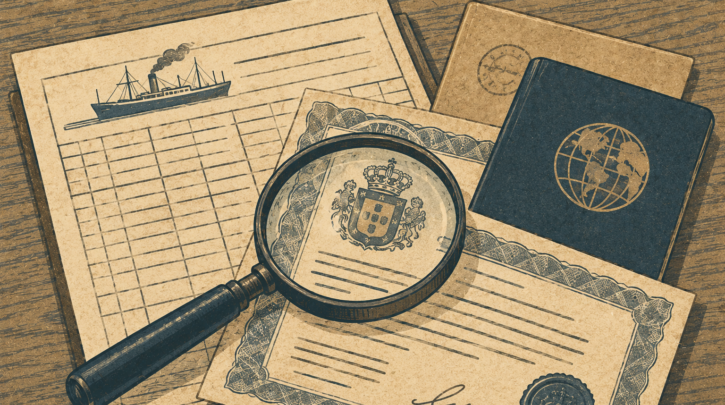
- Passenger and arrival records — ship lists naming the origin or last residence.
- The name in every form — including any anglicised or altered spelling, since Portuguese names changed abroad.
Not sure where to start with your Portuguese ancestry?
Get the Portuguese Genealogy Quick-Start Checklist — a 5-step path to your first real ancestor record, plus the two-surname naming system that trips up almost every beginner.
Use the Portuguese passport registers
A powerful and distinctively Portuguese resource is the passport register (registo de passaportes). Portuguese emigrants generally required passports to leave, and the district archives hold registers of these—often naming the emigrant’s parish, age, destination and more. Because they were created in Portugal at the point of departure, passport registers can link an emigrant directly to their home freguesia, making them one of the best bridges across the ocean. Many are being catalogued and digitised, and they are well worth seeking for any emigrant ancestor.
Look for the naturalidade in Portuguese-language records
Portuguese records—and records created by Portuguese institutions abroad, such as Catholic parishes—have a wonderful habit of recording naturalidade, a person’s place of birth or origin. A marriage or baptism recorded in a Portuguese community abroad may name the exact home parish; a record back in Portugal will. Training yourself to look for and capture every mention of naturalidade is one of the most productive habits in Portuguese diaspora research, because that single field so often contains the parish you are seeking.
Confirm in the Portuguese records
Once a source gives you a candidate parish or island, confirm it in the Portuguese records. Look for your emigrant’s baptism there—in the civil records if after 1911, the parish registers if before—with the parents’ names and dates matching what you know. Finding them, with details aligning (and Portuguese baptisms often naming grandparents to cross-check), confirms you have the right place and person, not a coincidental match. This confirmation is especially important given how variable Portuguese names are.
Handle the naming and spelling
Two naming difficulties recur and should be planned for. First, Portuguese surnames were variable even at home, so match your emigrant by parents, origin and dates rather than surname alone. Second, names were often altered abroad—anglicised in North America (Silva to Sylvia, Sousa to Souza, and many more)—so you may need to reverse the change to recognise the Portuguese original. Neither difficulty is insurmountable; both simply call for flexibility and for reconstructing the whole family group rather than trusting a single spelling.
Mainland or island?
A crucial early determination is whether your emigrant came from the mainland or the islands, since this decides which body of records holds their origin. Records abroad, family tradition, and the clustering of island communities can all indicate island origin—and if the family is from the Azores or Madeira, you will look to the islands’ regional archives rather than the mainland district archives. Establishing this early prevents wasted searching and focuses the hunt on the right island and parish.
Crossing the ocean in your research
Finding the emigrant ancestor and their parish is the pivotal achievement in Portuguese diaspora genealogy—the moment your family’s story stops being American, Canadian or Brazilian and becomes Portuguese, reaching back into records that may run to the 1600s. It can take patience, especially with an altered name or an uncertain island, but the density of Portuguese records—the passport registers, the origins named everywhere, the rich parish books—means the parish is usually recoverable. Once you have it, everything in our research guides is open to you—and, potentially, a route to citizenship as well.