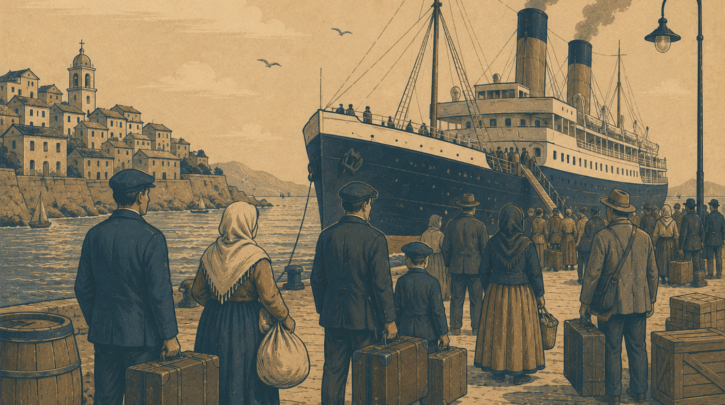

Portuguese immigrants built distinctive and enduring communities across the United States, and their story is disproportionately an island story. The overwhelming majority came not from mainland Portugal but from the Azores and Madeira, two small Atlantic archipelagos that sent people abroad in numbers far out of proportion to their size.
Knowing where the Portuguese settled in America is more than background history: because emigrants from the same island, and often the same village, clustered together when they arrived, these settlement patterns are one of the most useful tools available for tracing a Portuguese-American family back across the ocean to the exact parish it came from. This guide covers the major communities, why they formed where they did, and how to turn that geography into a genealogical breakthrough.
Not sure where to start with your Portuguese ancestry?
Get the Portuguese Genealogy Quick-Start Checklist — a 5-step path to your first real ancestor record, plus the two-surname naming system that trips up almost every beginner.
New England: From Whaling Ports to Mill Towns
The oldest and largest Portuguese-American communities grew up in New England, and their story begins, unexpectedly, with whaling. In the early nineteenth century, American whaling ships regularly stopped at the Azores to take on supplies and recruit crew, and Azorean men signed on in large numbers, drawn by wages and a route out of island poverty. Many of these men eventually settled permanently in the whaling ports that had recruited them, above all New Bedford and Fall River in Massachusetts, along with parts of Rhode Island.
As the whaling industry declined through the later nineteenth century, it was replaced by another labour-hungry industry that kept the Portuguese communities growing: textiles. The great cotton mills of New Bedford, Fall River, and the surrounding towns drew wave after wave of Azorean immigrants, and later Madeirans and mainland Portuguese as well, into steady industrial work. Fishing offered a second economic anchor, particularly in New Bedford, which remains one of the most important fishing ports in the country and still has a strongly Portuguese fishing fleet today.
These New England communities are, even now, among the most densely Portuguese places in America. Their parishes, feast-day associations, social clubs, and Portuguese-language institutions have persisted for well over a century, giving researchers an unusually rich body of community records to draw on.
California: Dairy Farms and Fishing Fleets
A second major current of Portuguese emigration flowed to California, and here again the Azoreans dominated. Beginning in the mid-to-late nineteenth century and continuing through the twentieth, Azorean immigrants became central to California’s dairy industry, particularly in the Central Valley and the counties north of San Francisco. Portuguese-American families built multi-generational dairy operations, and Portuguese surnames remain common among California dairy farmers to this day. A second, smaller stream settled in the fishing communities along the California coast, particularly around Monterey and San Diego, drawing on the same maritime skills that had shaped Azorean life for centuries.
Like their New England counterparts, Portuguese-Californian communities kept a strong island identity across generations, maintaining Holy Ghost festas, mutual aid societies (the IDES, or Irmandade do Divino Espírito Santo, is especially important here), and parish networks that still function as living archives of family origin.
Hawaii: The Sugar Plantation Migration
A distinctive and often overlooked branch of Portuguese America took root in Hawaii. Beginning in 1878, Hawaiian sugar plantation owners recruited Portuguese labourers directly from Madeira and, to a lesser extent, the Azores, to work the plantations, a program that continued for roughly two decades and brought thousands of Portuguese immigrants directly to the islands. This community left a permanent cultural mark on Hawaii, most famously through the ukulele, which Portuguese immigrants adapted from a small four-stringed Madeiran instrument called the machete or braguinha.
Descendants of these plantation-era immigrants form a distinct branch of the Portuguese-American diaspora, one whose roots lead specifically back to Madeira far more often than to the Azores, and whose immigration and labour contracts, unusually, were often recorded in considerable detail because they arrived under organized recruitment schemes rather than as individual emigrants.
Smaller Communities Worth Knowing
Beyond these three major centres, smaller but historically significant Portuguese communities took root elsewhere in the country, including fishing and canning towns in the Pacific Northwest, industrial centres in Connecticut and New Jersey, and pockets of later twentieth-century settlement in Florida and elsewhere as the community diversified. If your family’s story does not fit neatly into New England, California, or Hawaii, it is still very likely part of a documented, if smaller, Portuguese-American settlement pattern, and local historical societies in the area your family settled are often the fastest way to confirm it.
Confirm Mainland or Island Origin First
Before going further in your research, settle one foundational question: did your family come from the Portuguese mainland or from the islands? Given that the overwhelming majority of Portuguese-American families trace to São Miguel, Terceira, Faial, or Madeira rather than to Lisbon or Porto, island origin is the safer starting assumption, but it should be confirmed rather than guessed. This single fact determines which body of records holds your family’s story: the islands maintain their own regional archives, separate from the mainland district archives, and searching in the wrong one wastes time and can lead you to the wrong family entirely.
Community, Faith, and the Festas
Portuguese-American life, wherever it took root, was held together by three institutions: the Catholic parish, the social or fraternal club, and above all the festa. The Holy Ghost festivals, or festas do Espírito Santo, central to Azorean religious life, were transplanted wholesale to New England, California, and Hawaii, and are still celebrated with real devotion in these communities today. These institutions were never just social or religious in a narrow sense. Parish baptismal and marriage registers, festa association membership rolls, and mutual aid society records all tend to preserve exactly the kind of detail that genealogists need: not just names and dates, but specific villages, parishes, and islands of origin, since immigrant communities took real pride in remembering, and recording, exactly where their members came from.
Turning Settlement Patterns Into a Research Method
This is where the history above becomes genuinely useful rather than merely interesting. Because Portuguese immigrants clustered so tightly by island, and frequently by individual village, the community your ancestor settled in is itself a strong clue to their origin in Portugal. A few concrete ways to use this:
Study the composition of the local Portuguese community your ancestor belonged to. Local histories, festa association records, and community-published anniversary books frequently name which specific islands, or even which specific villages, most of a given community’s founders came from.
Read the Catholic parish records with real attention, not just for your own family’s entries but for the pattern of origins recorded across the parish generally. Portuguese national parishes abroad were often meticulous about recording a member’s naturalidade, their place of origin, sometimes more completely than the equivalent American civil records did.
Pay close attention to who your ancestor married, and who stood as godparents or witnesses at baptisms and weddings. Because these communities were so tightly interconnected by origin, an in-law’s or godparent’s recorded naturalidade is very often the same parish or island as your own ancestor’s, even when your direct ancestor’s own origin was never explicitly written down.
American Records Worth Searching
Alongside parish records, a specific set of American record types tend to be unusually productive for Portuguese research, and are worth searching systematically:
Naturalization records frequently name a specific Portuguese birthplace, and later twentieth-century naturalization files in particular can be remarkably detailed, sometimes down to the exact parish or freguesia.
Ship manifests and passenger arrival lists, especially those from the major ports of entry such as New Bedford, Providence, Boston, and New York, commonly list a last place of residence in Portugal, which for most Portuguese emigrants was also their birthplace.
Federal census records from 1900 onward recorded both birthplace and year of immigration, which is useful even when it does not name a specific parish, since it lets you narrow the window in which to search Portuguese emigration and passport records.
City directories and Portuguese-language newspapers published within these immigrant communities are an underused resource. Obituaries, wedding announcements, and social notices in papers serving New Bedford, the Azorean communities of California, or Portuguese Hawaii frequently named the specific home village of the person being written about, information that almost never appears in the equivalent English-language American records.
From Community to Origin
The strong, tightly-knit character of Portuguese-American communities, which can feel like an obstacle to outsiders trying to understand them, is in fact a real gift to the genealogist. Because these communities so deliberately preserved their ties of family, faith, and origin, and because so much of that preservation took documentary form in parish books, festa association records, and community-published histories, the path from a Portuguese-American family back to a specific island parish is very often recoverable, even after a century or more, with patience and the right sequence of searches.
The method, in short, is this: identify the community your immigrant ancestor belonged to, learn its general origin pattern, and use every occurrence of naturalidade you can find, whether attached to your ancestor directly or to the people around them, to build toward a specific parish or island. Once that place is confirmed, the deep and often free Portuguese civil and parish records, many of them digitized on FamilySearch, open up completely, and the story that began in a New Bedford mill, a California dairy farm, or a Hawaiian sugar plantation can be carried, generation by generation, all the way back to the village it started in.