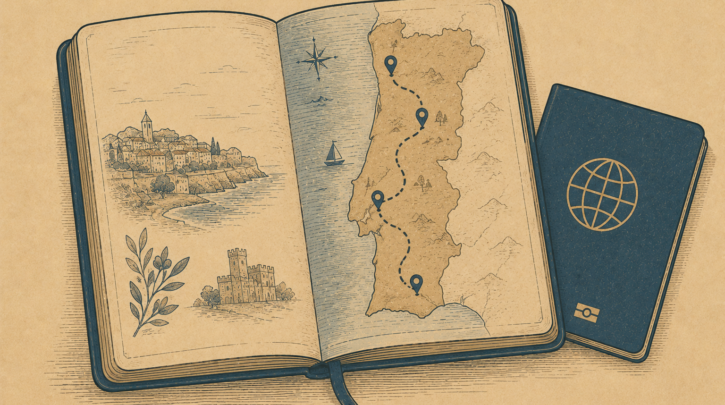

There is a moment in many family-history journeys when the names in the registers are no longer enough—when you want to stand in the village your great-grandparents left, see the church where they were baptised, walk the island your family sailed from before the great migration. A Portuguese heritage trip turns generations of records into something you can touch. This guide will help you plan one that is genuinely yours—not a generic tour of Lisbon, but a journey to your family’s village, parish or island.
In Portugal, such a trip has a clear heart: the freguesia (parish) and village your ancestors’ lives were recorded in—and, for the many families of island origin, the specific island they came from. Planning a Portuguese roots trip means identifying that place and building a journey around the real world your family knew.
Step one: do the genealogy first
Before you book anything, identify the exact place your family came from. A heritage trip built on “somewhere in Portugal”—or even “the Azores”—is just a holiday; a trip built on “the freguesia of X, where my great-grandparents married in 1878” is a pilgrimage. Because Portuguese records and identity are organised around the parish, finding your ancestral parish—and whether it is on the mainland or the islands—is the essential first task, and our guide to finding your emigrant ancestor shows how to trace it.
The whole trip begins with the place. Identify it using the records—see the records hub—and consider testing beforehand so you can meet living cousins on the journey.
Step two: research the place before you go
Once you know the parish or island, learn everything you can before you travel. Find the village on a map, read its history, identify the church and the cemetery, and—if possible—make contact in advance with the parish, a local association, or relatives. Doing the records research first, much of it free on FamilySearch, means you arrive knowing exactly which ancestors were born, married and buried there—so that standing in the church or the village, you are meeting documented people, not abstractions. Our guide to visiting your ancestral village covers this in detail.
Step three: mainland or island?
A defining question shapes any Portuguese heritage trip: is your family’s origin on the mainland or the islands? The Azores and Madeira are a world apart—reached by separate flights, with their own landscapes, culture and rhythm—and a great share of the diaspora, especially in North America, traces to them. If your roots are in the islands, your trip is an island journey, and planning it well (which island, which village) is essential. If they are on the mainland, you will be travelling to a region and village of continental Portugal. Establishing this early determines the whole shape of the trip.
Step four: time it for the festas
If you can, time your visit for a festa. Portuguese village and island life revolves around religious festivals—patron-saint celebrations, romarias (pilgrimages), and above all, in the Azores and the diaspora, the Holy Ghost (Espírito Santo) festivals—concentrated especially in the summer months. Experiencing your ancestral village or island during its festa, with its processions, music, food and community, is one of the most vivid ways to connect with the living culture your family carried abroad, and to meet the community. Just be aware that summer also brings heat and crowds, so weigh the trade-offs.
Step five: connect with relatives and community
One of the most rewarding parts of a Portuguese heritage trip is human connection. Many families still have relatives in the ancestral village or island, and because the diaspora tests DNA in large numbers, a test taken before the trip can connect you with cousins who may welcome you and show you the family’s places. Local parishes, associations and—for island families—the tight community networks often receive returning descendants warmly. Reaching out ahead of time can turn a visit from sightseeing into a genuine homecoming, and the strong ties Portuguese emigrants kept to home villages mean the welcome is often heartfelt.
Practical planning
A few practicalities smooth a Portuguese heritage trip. The mainland is reached through Lisbon or Porto and is easy to travel by car or rail; the islands require separate flights, and island-hopping in the Azores means further inter-island travel. English is widely spoken in cities and tourist areas but less so in rural villages and the interior, where a little Portuguese helps greatly—and connects you to the heritage. Spring and autumn are milder and quieter than the busy, hot summer, though summer holds the festas. Contact any parish, archive or relative ahead if you hope to see specific places, and consider basing yourself regionally and driving out to the rural parishes where so many families originated.
More than a trip
The best Portuguese heritage trips connect you to your own people and places—the church where your ancestors were baptised, the cemetery where the family names are carved, the fields or the harbour they knew, the festa that expresses their faith and joy. Carry a copy of your traced line so that, standing in the village, you know exactly who lived there. For some, such a trip is also the first step toward reclaiming the wider heritage—the language, the traditions—and even toward Portuguese citizenship. Whatever it leads to, standing at last in your family’s Portuguese village is what the whole journey through the records was quietly leading toward.