
For the many descendants of Portuguese emigrants whose grandparent was Portuguese—but whose parent was born and raised abroad—Portugal offers a genuine and well-established route to citizenship. Unusually generous by international standards, it lets grandchildren claim Portuguese citizenship of origin by declaration, subject to a basic language requirement and proof of ties. For much of the diaspora, this is the route that matters most. This guide explains how it works, what it requires, and how to prepare—and, encouragingly, it was unaffected by the 2026 reform.
Important: This article is general information for educational purposes, not legal advice. Portuguese nationality law is detailed and changed substantially in 2026, and any individual case depends on its particular facts. Always verify your situation with the Portuguese authorities (the IRN — Instituto dos Registos e do Notariado, and the Conservatória dos Registos Centrais) or a qualified professional before acting.
Not sure where to start with your Portuguese ancestry?
Get the Portuguese Genealogy Quick-Start Checklist — a 5-step path to your first real ancestor record, plus the two-surname naming system that trips up almost every beginner.
Citizenship of origin, by declaration
The grandparent route grants Portuguese citizenship of origin (originária)—meaning you are treated as Portuguese from birth, not naturalised later—acquired by making a formal declaration of intention to be Portuguese. This is a real generosity: many countries stop citizenship by descent at the parent, but Portugal explicitly reaches grandchildren, and treats them as citizens of origin. The route rests on proving your descent from a Portuguese grandparent and meeting the conditions below, after which your declaration establishes your citizenship.
The language requirement: CIPLE A2
The most significant condition is a Portuguese language requirement: you must demonstrate a basic command of Portuguese, at the A2 level, typically through the official CIPLE examination (the Certificate of Initial Portuguese as a Foreign Language). A2 is an elementary level—enough to handle simple, everyday communication—so it is achievable for a motivated learner without fluency, and many applicants prepare specifically for the exam. This language requirement is the main hurdle of the grandparent route, but a very surmountable one, and it connects you to the heritage in a meaningful way.
Proof of ties to the community
The route also requires demonstrating ties to the Portuguese national community. Since the 2020 reforms that opened this route more widely, this connection can, in practice, be substantially shown through the knowledge of the Portuguese language itself, along with other links to Portugal a family may have. The requirement reflects Portugal’s wish that new citizens by this route have a genuine connection to the country and its culture—a connection that tracing your family, learning the language, and engaging with your heritage all help to establish and evidence.
Proving descent from the grandparent
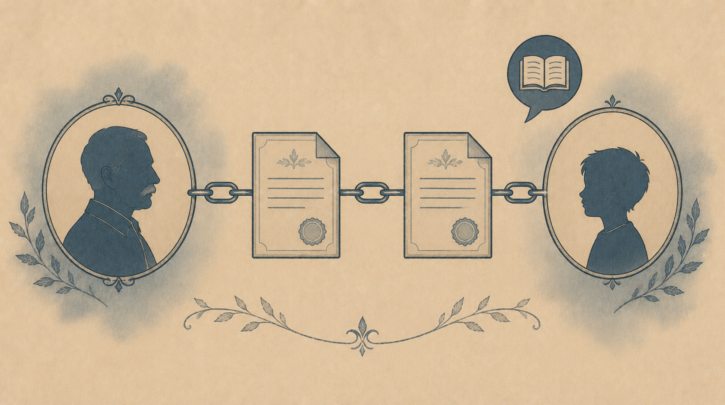
At the heart of the claim is documenting the chain from your Portuguese grandparent to you. You must prove your grandparent’s Portuguese citizenship (usually via their Portuguese birth record), then the link from grandparent to your parent, and from your parent to you—a chain of birth and, where relevant, marriage certificates. Because Portuguese names were variable, assembling a clean, consistent documentary chain is exactly the disciplined records work our research guides teach, and it is the foundation of a successful application.
The broken-chain question
As with all descent routes, the chain must be intact: if your grandparent had lost or renounced Portuguese citizenship before your claim, it may complicate matters. However, because this route grants citizenship of origin directly to the grandchild based on descent from a Portuguese grandparent, and because Portugal has allowed dual citizenship since 1981, it is often more forgiving than one might fear—but an ancestor who formally lost citizenship in an earlier era is a factor to investigate. Establishing your grandparent’s citizenship status is part of preparing the claim, and a question to confirm with the authorities.
The documents you need
A grandparent-route application typically requires the grandparent’s Portuguese birth certificate; the chain of birth and marriage certificates linking grandparent to parent to you; your CIPLE A2 certificate; identity documents; criminal-record certificates as required; and the declaration itself—with foreign documents apostilled and translated. The application goes to the Conservatória dos Registos Centrais, often via a consulate. The full picture is in requirements and process.
A realistic and rewarding route
The grandparent route is genuinely achievable for a committed applicant: the language requirement is basic, the ties can be shown substantially through that language, and the documentation—while demanding—is exactly what family-history research produces. For a descendant with a Portuguese grandparent, an EU passport is a realistic goal, and the journey to it—tracing the family, learning some Portuguese, engaging with the heritage—is rewarding in itself. Start by documenting your grandparent with the records, begin learning Portuguese toward the A2 exam, and verify the current requirements with the Portuguese authorities before you proceed.