
Canada is home to one of the largest and most vibrant Portuguese communities in the world, and—unlike the older Portuguese settlements of the United States and Brazil—it is largely a story of the twentieth century, above all the decades after the Second World War. If your Portuguese family settled in Canada, they were part of a great post-war migration that transformed Canadian cities. This guide traces that story and shows how to research a Portuguese-Canadian family.
The post-war migration
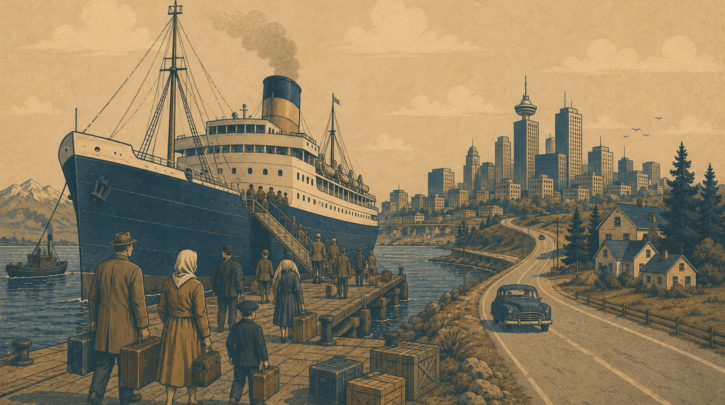
Large-scale Portuguese emigration to Canada began in earnest in the 1950s. A landmark was the arrival of the first organised groups of Portuguese immigrants in 1953, and from there the movement grew rapidly, as Canada sought immigrants and Portugal’s emigrants—fleeing poverty and, for young men, conscription and the colonial wars—sought opportunity. Through the following decades, hundreds of thousands of Portuguese settled in Canada, building communities that remain among the country’s most distinctive.
Not sure where to start with your Portuguese ancestry?
Get the Portuguese Genealogy Quick-Start Checklist — a 5-step path to your first real ancestor record, plus the two-surname naming system that trips up almost every beginner.
The Azorean character
Like the Portuguese communities of the United States, Portuguese Canada is heavily island-derived, and Azorean in particular. A great share of Portuguese-Canadian families trace to the Azores—especially islands such as São Miguel—rather than the mainland. This Azorean character shapes the community’s culture, its festas and its ties home, and it is a crucial orientation for research: a Portuguese-Canadian family is more likely than not to have island origins, pointing to the islands’ regional archives.
Toronto and the major communities
The heart of Portuguese Canada is Toronto, which developed one of the largest Portuguese communities in North America, centred historically on neighbourhoods that became vibrant hubs of Portuguese life. Beyond Toronto, significant Portuguese communities grew across Ontario, in Montreal, in parts of British Columbia and elsewhere. These urban communities, built by post-war immigrants and their families, sustain a rich Portuguese-Canadian culture—its parishes, businesses, clubs and festivals—that keeps the connection to Portugal strongly alive.
Community and identity
Portuguese-Canadian communities, like their American counterparts, were anchored by Catholic parishes, social and cultural clubs, and the festas that express Azorean and Portuguese identity. These institutions preserved the language, the faith and the customs—and, valuably for the researcher, ties to specific home islands and villages. The strong cohesion of Portuguese Canada, and its relatively recent formation, mean that living memory and community records often preserve clear knowledge of families’ exact origins.
An advantage of recency
The relatively recent nature of Portuguese emigration to Canada is a genuine research advantage. Because most Portuguese-Canadian families arrived in the second half of the twentieth century, the immigrant generation and their children are often within living memory, family documents and photographs survive, and the emigrant’s origins are frequently still known or easily recovered. Twentieth-century immigration, naturalisation and travel records are also more plentiful and detailed than those for earlier eras, making the crucial link back to the Portuguese parish often more straightforward than for older diasporas.
Researching a Portuguese-Canadian family
Tracing a Portuguese-Canadian family follows the familiar path, aided by that recency. Work back through Canadian records—immigration and travel records, naturalisation, church and community records—and through family knowledge, which for a recent migration is often rich, to identify the immigrant and their origin. Look especially for the naturalidade—the island and parish—and confirm island versus mainland origin. Then cross to the Portuguese island or mainland records, much of it free on FamilySearch, to trace the family back home.
A living connection
The Portuguese heritage of Canada is not a museum piece but a living, thriving tradition, sustained in Toronto and across the country in festas, parishes, clubs and family. For descendants, this means both a warm community context for tracing the family and—because the migration is recent and the ties strong—often a genuinely recoverable path back to a specific island village. And for those who qualify through a Portuguese parent or grandparent, the connection can extend even to Portuguese and EU citizenship—making the Portuguese-Canadian family history a bridge not only to the past but potentially to the future.
Canadian records for a Portuguese family
The Canadian side of a Portuguese-Canadian search offers rich, relatively recent material worth knowing. Twentieth-century immigration and travel records, naturalisation and citizenship records, and the records of the Portuguese Catholic parishes and community organisations founded across Toronto, Ontario and beyond can all help identify an immigrant and, often, their island or village of origin. Because the migration is recent, family sources—documents, photographs, and the memories of the immigrant generation and their children—are frequently abundant and are often the quickest route to the crucial naturalidade. Combined with the strong, well-documented cohesion of Portuguese-Canadian communities—which clustered tightly by island and village—these records make the path back to a specific Portuguese parish more straightforward than for many older diasporas, so a Portuguese-Canadian line is often among the more tractable to trace across the ocean.