
You took a DNA test expecting a clear “Portuguese” result, and instead you got “Portugal and Spain,” or a broad Iberian figure, perhaps with unexpected traces of other regions and percentages that shift with every update. This is normal, and it reflects real features of Iberian ancestry: the peoples of the peninsula are closely related, and Portugal’s history layered many influences into its population. Understanding why helps you read your results sensibly. This guide explains what Portuguese DNA results really mean—and what they cannot mean.
Not sure where to start with your Portuguese ancestry?
Get the Portuguese Genealogy Quick-Start Checklist — a 5-step path to your first real ancestor record, plus the two-surname naming system that trips up almost every beginner.
The Iberian blur
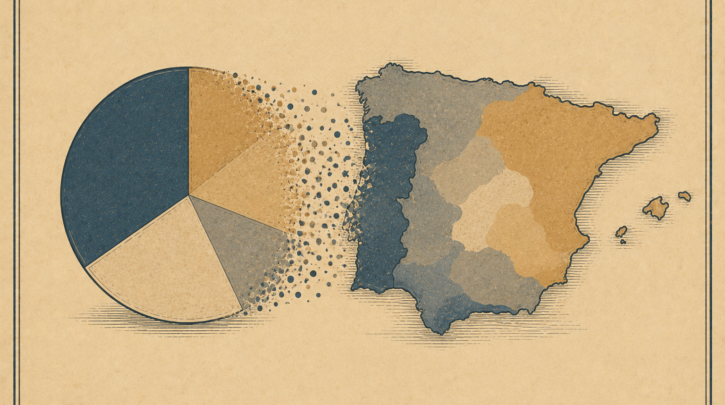
The central fact about Portuguese ethnicity estimates is the Iberian blur: Portuguese and Spanish ancestry are genetically very similar and hard to separate. The peoples of the Iberian Peninsula share deep common ancestry and have intermingled across the centuries, so the testing companies—which estimate ethnicity by comparing your DNA to reference populations—often cannot cleanly distinguish Portuguese from Spanish. As a result, a thoroughly Portuguese family commonly receives a broad “Portugal and Spain” or Iberian estimate rather than a precise “Portuguese” figure. This does not mean your test is wrong; it means Portuguese ancestry does not carry a sharply distinct genetic signature separable from its Iberian neighbours.
The layers of Iberian history
Portuguese DNA also carries the imprint of Iberia’s layered history, which can surface as small, sometimes surprising components in your estimate. Over millennia the peninsula saw Celts and Romans, Germanic peoples (the Suebi and Visigoths), centuries of Moorish (North African and Arab) presence, and a significant Jewish population. So a Portuguese result may include minor traces of North African ancestry (from the Moorish period) or of Jewish (Sephardic) ancestry, alongside the dominant Iberian component. These small components are a genuine echo of Portugal’s rich past, though—being small and old—they are estimates to interpret with care rather than precise measures.
The Sephardic and converso trace
The possible Jewish (Sephardic) trace deserves a note, because it connects to Portuguese history and to family traditions. Portugal had a substantial Jewish community before the forced conversion of 1497, after which many became New Christians, and converso ancestry became widespread in the population. Some Portuguese therefore carry a small amount of Sephardic Jewish DNA. But such traces are typically small and ancient, and—importantly—cannot prove specific Sephardic descent, nor do they offer any citizenship route, since Portugal’s Sephardic route has closed. Treat a Sephardic trace as an intriguing hint about deep ancestry, not as documentation.
Why the estimates keep changing
Another common surprise is that your ethnicity percentages change over time, sometimes noticeably, without any new fact entering your tree. This is because the companies periodically update their methods and reference panels, re-estimating everyone’s results. For Iberian ancestry, where the signal is already blurry and the historical layers subtle, these revisions can shift the Portuguese, Spanish and minor components around from one year to the next. That instability is itself a reason to hold the numbers loosely: an estimate that can change overnight is not the kind of evidence on which to build a genealogy.
Regional estimates: improving slowly
The companies try to offer finer, sub-regional breakdowns—sometimes suggesting a more specific part of Portugal or distinguishing Portugal from Spain—and these have improved over time. But for Portugal the resolution remains limited, and any sub-regional estimate should be treated as an interesting, evolving guess rather than a fixed fact, and certainly not as a substitute for documentary evidence of where your family lived. The records, not the ethnicity map, are what can name your parish or island.
What ethnicity estimates cannot do
The single most important thing to remember is that an ethnicity estimate cannot name your parish or island, or reliably distinguish Portugal from Spain. For Portuguese ancestry, where the signal is a broad Iberian blend with subtle historical layers, this is especially true: the percentages confirm a general Iberian origin you likely already suspected, and hint at the deep history behind it, but they cannot point to the parish—only the records and your DNA matches can do that. Enjoy the broad-strokes story your DNA tells about your Iberian roots and their ancient layers, but build your genealogy on the documents.
The right way to read your results
So read your Portuguese ethnicity estimate for what it is: a fascinating, broad-strokes picture of Iberian ancestry and its historical layers, not a precise or stable measurement, and never a substitute for research. Notice the dominant Iberian component, take interest in any North African or Sephardic traces as echoes of Portugal’s past, and hold the shifting percentages lightly. Then turn to the part of your results that can advance your genealogy—your matches—and to the rich Portuguese records that alone can carry your family back, parish by parish, through the centuries.