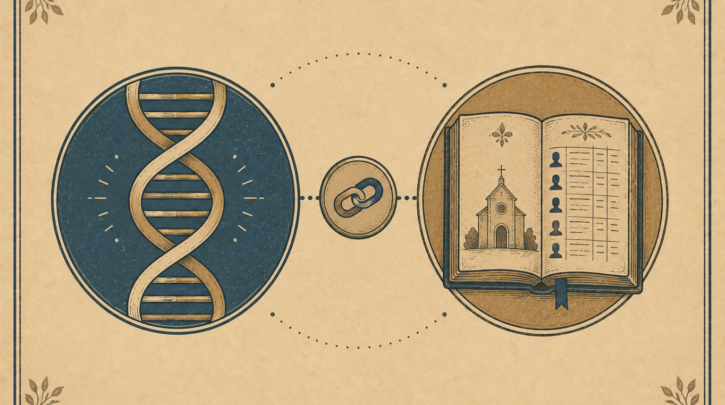

A DNA match is a clue, not a conclusion — the work that turns it into real genealogy happens in the records, not in the match list itself. But the questions that come up while doing that work are rarely generic. They’re specific: a match from the wrong island, a parish register that stops cold in the 1700s, a shared surname that might mean everything or nothing. Below are the questions readers actually ask when they sit down to turn a Portuguese or Azorean DNA match into a documented relationship.
Not sure where to start with your Portuguese ancestry?
Get the Portuguese Genealogy Quick-Start Checklist — a 5-step path to your first real ancestor record, plus the two-surname naming system that trips up almost every beginner.
Questions about islands, migration, and matching across regions
My match’s family is from a different Azorean island than mine — could we still be related?
Yes, and this is more common than testers expect. The islands were not settled or repopulated in total isolation from one another: inter-island migration happened throughout Azorean history, particularly after natural disasters like volcanic eruptions or earthquakes displaced entire parishes to other islands, and some families simply moved for land, work, or marriage. It is also worth remembering that many island-founding families originated from the same handful of mainland regions before island settlement even began, so a shared ancestor further back can predate either family’s arrival on their respective island entirely. Treat a cross-island match as a genuine lead, not a contradiction — but you will need documented descent on both sides to find where the lines actually meet, since the connection may sit several generations before either family reached its current island.
My matches all show as closer cousins than makes sense — what’s going on?
This is the single most common surprise for Azorean and Madeiran testers, and it almost always comes down to island endogamy. Because island populations were small and largely closed for generations, most island descendants are related to each other along several different lines at once, not just one. DNA companies estimate closeness assuming a single shared line, so someone connected to you through three or four lines at once can report as “second cousin” when every individual line is genuinely more distant. Do not discard these matches — they are still real relatives — but do not trust the predicted label either. Build both trees back in the records and let the documented connection, not the algorithm, tell you how close you actually are.
I don’t know which island or parish my family is from. Can DNA alone tell me?
DNA alone rarely names a specific parish, but it can point you toward one. If several matches independently trace to the same Portuguese place and connect to you through a plausible shared line, that place becomes a strong candidate worth searching directly in the records. The practical approach is to message your closest well-documented matches, ask what parish or island their own research points to, and look for a pattern rather than relying on any single match’s tree, which may itself be undocumented guesswork. Once a candidate parish emerges, the actual confirmation still comes from the parish and civil records themselves, not from the DNA match list.
Questions about names and common surnames
My match and I share a common surname like Silva or Santos — does that confirm we’re related?
No, and this is worth internalizing before you go any further. Names like Silva, Santos, and Costa are carried by an enormous number of unrelated Portuguese and Azorean families, so a shared common surname between you and a match is essentially a coincidence, not evidence. Your actual DNA match is real — you are genuinely related somehow — but the surname you both happen to carry is very unlikely to be the reason. Set the surname aside entirely and reconstruct both families’ actual documented lines; the real connection, if you can find it, will usually run through a different, more specific detail than the name you started with.
My match has a completely different surname from mine. Could we still be related?
Very possibly, and this is where Portuguese naming conventions matter most. Historically, a child might carry a father’s surname, a mother’s, or a grandparent’s, and which surname a family ultimately settled on and carried forward could shift by generation or even by individual sibling. A completely different surname today does not rule out a shared ancestor several generations back; it may simply mean the two branches of the family ended up carrying different names from among several that existed in the tree. Confirm through parents, grandparents, godparents, and place — the details that actually identify a specific person in the parish register — rather than through the surname at all.
Questions about hitting the record wall
The parish records for my ancestral village only go back to the 1700s. Now what?
This is a real wall, and there is no way around it if the earlier registers genuinely no longer exist — some were lost to fire, flooding, or simple deterioration over the centuries. A few avenues are still worth checking first. Confirm with the holding district or regional archive whether the gap reflects genuinely lost records or simply records not yet digitized or indexed, since the two look identical from a home search but require different next steps. Check whether neighboring parishes hold relevant entries — a family sometimes appears there for a marriage or a godparent role even when its own parish’s earliest books are lost. And lean more heavily on DNA matches whose trees may independently reach a generation further back than yours, since a well-documented match can sometimes supply exactly the generation your own records can no longer confirm. When the paper trail genuinely ends, it is reasonable to record the wall as a wall rather than force a connection the records cannot support.
My match has traced their tree further back than I have. Should I just copy their tree?
Not without verifying it yourself. Online trees, including a match’s own, are a starting hypothesis, not a source. Treat any generation your match has added beyond what you’ve confirmed as a lead to check in the actual parish or civil registers, not as an established fact simply because it appears in someone else’s tree. This matters even more in Portuguese research than in many other traditions, because undocumented online trees frequently connect people through nothing more than a shared common surname — exactly the kind of false connection discussed above. A shared DNA match with someone doesn’t make their unsourced tree correct; it makes it worth checking.
Questions about process and limits
How much shared DNA should I expect from a real Azorean third cousin?
Less predictably than a textbook answer would suggest. Standard centimorgan charts are built from outbred populations and assume a single line of relationship, so they work reasonably well for many mainland Portuguese matches. For island-descended matches, expect the actual shared DNA to run higher than the chart predicts for a given documented relationship, precisely because endogamy means you are very often related through more than one line at once. Use standard charts as a loose starting point for island matches, not a precise measurement, and let the documented family reconstruction — not the centimorgan total — be the final word on how you connect.
Can DNA evidence help with a Portuguese citizenship application?
No. This is worth stating plainly: Portuguese citizenship by descent turns entirely on a documented chain of birth and civil status certificates linking you to a Portuguese citizen ancestor. A DNA match, a shared centimorgan total, or even a well-documented tree built primarily from a match’s research carries no legal weight in a citizenship application. DNA can help you find the right ancestor and the right parish to search for the actual certificates; it cannot substitute for those certificates themselves. This is general information, not legal advice — verify any specific citizenship question with the Portuguese authorities or a qualified professional.
My closest match and I can’t find the connection in the records at all. Where do I look next?
First, double-check that you have both reconstructed complete sibling groups, not just direct-line ancestors — a connection sometimes runs through a sibling of a known ancestor rather than the direct line itself, which is easy to miss if you have only built a narrow pedigree chart. Second, consider whether an undocumented event — an unrecorded adoption, an illegitimate birth attributed to a different father in the record, or a godparent relationship mistaken for a biological one somewhere in family memory — could explain a real genetic connection that the paper trail doesn’t show cleanly. Third, if both families trace to the islands, revisit the endogamy question above: a close-looking match with no findable single connection is sometimes the combined signal of several distant shared lines rather than one close one, in which case there may be no single clean answer to find.
The discipline that makes it worth doing
Every one of these questions has the same underlying answer: the DNA tells you that a connection exists; the records tell you what it actually is. That discipline — treating every match as a hypothesis to confirm in the parish and civil registers, never as a conclusion on its own — is what makes a Portuguese or Azorean family tree durable rather than merely plausible. The research guide covers the same documentary approach in full, and is worth revisiting whenever a new match raises a question this list didn’t quite answer.