
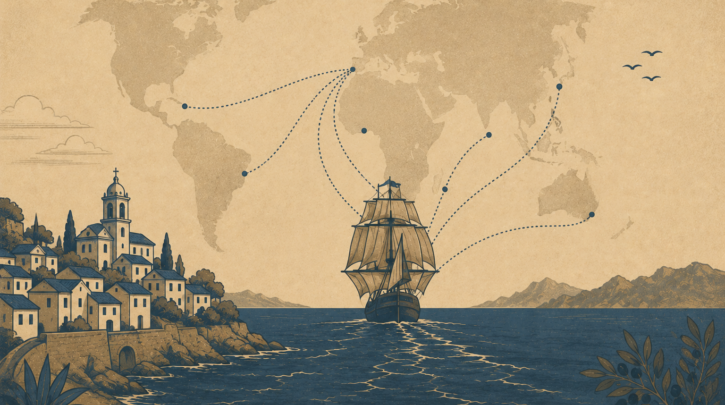

Few nations of Portugal’s size have sent so many of their people across the world. From the age of the colonial empire through the twentieth century, Portuguese emigrants left in extraordinary numbers—for Brazil above all, but also for the United States, Canada, France, Venezuela and far beyond. The result is a Portuguese diaspora many times larger than Portugal’s own population, and if your family came from Portugal, they were almost certainly part of it. This guide tells the story and shows how to trace an ancestor through it.
The scale of it
Portugal was one of the great emigrant nations of Europe, sending abroad a share of its people that few countries matched. The movement was sustained across centuries and reshaped both Portugal—emptying villages and, especially, the Atlantic islands—and the lands the emigrants settled, from the vast Portuguese communities of Brazil to the mill towns of New England and the suburbs of Toronto and Paris. For the family historian, the scale means two things: your emigrant ancestor was one of a vast, documented movement, and the records that movement generated are often rich and findable.
Brazil above all
One destination towers over the rest: Brazil. As Portugal’s colony until 1822 and then an independent, Portuguese-speaking nation, Brazil drew Portuguese emigrants in numbers that dwarf every other destination, in wave after wave from the colonial era into the twentieth century. For a great many Portuguese families, the emigrant relative went not to North America but to Brazil—a story of shared language and deep, continuing ties explored in Portuguese emigration to Brazil.
The islands: the diaspora heartland
For North America especially, the Portuguese diaspora is disproportionately an island story. The Azores and Madeira sent emigrants abroad in numbers out of all proportion to their small populations, and a great share of Portuguese-Americans and Portuguese-Canadians descend specifically from these islands rather than the mainland. Their distinctive emigration—to New England, California, Hawaii, Canada and elsewhere—is told in Azorean and Madeiran emigration, and it is essential to recognise if your roots lie in the islands.
Where else they went
Beyond Brazil and the island destinations, Portuguese emigrants settled widely, and a few streams stand out:
- The United States — New England, California and Hawaii above all, heavily Azorean and Madeiran; see Portuguese emigration to America.
- Canada — a major destination especially after the Second World War, centred on Toronto and Ontario; see Portuguese emigration to Canada.
- France and other European countries — the great labour emigration of the 1960s and 1970s, when huge numbers of Portuguese went to France.
- Venezuela, South Africa, Bermuda and others — smaller but significant communities, some strongly Madeiran.
Why they left
The reasons were a mix of hardship at home and promise abroad: poverty and limited land, especially on the islands; the pull of opportunity and, for Brazil, of a shared language; and—distinctively—the flight of young men in the 1960s and 1970s to escape military conscription and the colonial wars in Africa. We explore these in why the Portuguese emigrated. A recurring feature was the intention to return: many emigrants meant to earn abroad and come home, sent remittances, and kept strong ties to their home villages—ties that endure in the diaspora today.
Tracing an emigrant ancestor
For the genealogist, the great migration is not just history but a documented trail. Portuguese passport registers, passenger lists, the records your ancestor generated abroad, and—crucially—the origins (naturalidade) so often named in Portuguese records can carry you from an immigrant in New Bedford, Toronto or São Paulo back to a specific parish or island in Portugal, and from there into the deep parish registers. The whole method is laid out in finding your Portuguese emigrant ancestor.
A story worth recovering
The Portuguese diaspora is one of the defining facts of the modern Portuguese people, kept alive around the world in Catholic parishes, in the great festas of the Holy Ghost, in Portuguese clubs and in the fierce pride of the diaspora in its origins. Behind the vast numbers were individual families making a hard choice to leave everything for an uncertain future—and often dreaming of return. Recovering your family’s particular story, from the village or island they left to the place they built a new life, is what this cluster of guides, and this whole site, is here to help you do—and it can even lead to reclaiming Portuguese citizenship itself.
Waves and generations of emigration
It helps to picture the Portuguese diaspora as a series of overlapping waves, each with its own character, because knowing which wave your family belonged to shapes where and how you search. The colonial and nineteenth-century emigration to Brazil is the oldest and largest; the Azorean and Madeiran movement to New England, California and Hawaii built up from the whaling era through the early twentieth century; and the great post-war waves of the 1950s to 1970s carried Portuguese to Canada and, in enormous numbers, to France and other European countries. A family’s wave tells you the likely records, the likely destination communities, and often the likely reasons for leaving—so identifying it early orients the whole search.
These waves also differ in how recoverable they are. A post-war emigrant to Canada is often within living memory, with abundant twentieth-century records and family knowledge, while a nineteenth-century emigrant to Brazil or New England requires more documentary reconstruction. But in every case the Portuguese habit of recording origins, and the survival of rich records on both sides of the ocean, mean the connection back to the home parish or island is usually within reach for the patient researcher.