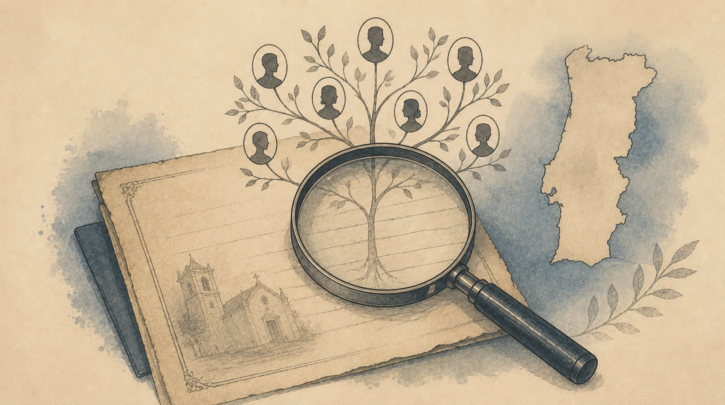

Portuguese ancestry is deeply rewarding to trace—and, in two ways, unusually generous to the researcher. First, an enormous share of Portugal’s records is digitised and free, so you can often work from home at little cost. Second, Portuguese records are frequently rich in detail: nineteenth-century baptism records commonly name not just the parents but the grandparents and the family’s village of origin, letting you leap back generations at a stroke. With patience and a clear method, most Portuguese families can be followed well into the 1700s, and often earlier. This guide lays out the whole journey.
Two features shape Portuguese research and are worth fixing in mind at the outset. First, there is a divide at 1911: from that year, the state kept civil registration of births, marriages and deaths; before it, the Catholic parish registers are your source, reaching back centuries. Second, Portuguese naming is famously variable—surnames were not fixed the way you might expect—so you learn to trace by families and places, not by a surname alone. We will guide you through both.
Step 1: Start at home
Before you touch a Portuguese record, mine your own family. The most important early facts are usually closer than you think—in documents, relatives’ memories, and the backs of photographs. Gather what you can:
- Names in full, in every form you can find, since Portuguese relatives may appear under varying surname combinations.
- The place of origin in Portugal—ideally the freguesia (parish) and concelho (municipality), the single most useful fact to establish; note whether the family came from the Azores or Madeira rather than the mainland.
- Approximate dates for birth, emigration, marriage and death, to anchor the search.
- Religion and any documents the emigrant generated abroad, which often name the Portuguese birthplace.
Not sure where to start with your Portuguese ancestry?
Get the Portuguese Genealogy Quick-Start Checklist — a 5-step path to your first real ancestor record, plus the two-surname naming system that trips up almost every beginner.
Step 2: Find the ancestral parish
If you do not yet know where in Portugal your family came from, finding it is your first real task, because the records are organised by parish and municipality. The best clues usually come from the records your ancestor generated after emigrating—which we cover in finding your Portuguese emigrant ancestor. Establish the freguesia, and Portugal’s rich records open before you.
Once you know the place, the records open up—and many are free. The Portuguese Records hub shows where everything lives, and our FamilySearch guide shows how to use the free collections.
Step 3: Work back through civil registration (from 1911)
From 1911, Portugal’s civil registration of births, marriages and deaths is your workhorse for the modern period. These records are detailed—naming parents, and often grandparents, with dates, places and occupations—and working backward from a known ancestor, each record leads to the next, until you reach the 1911 boundary and the parish registers beyond.
Step 4: Cross into the parish records (before 1911)
Before 1911, you move into the Catholic parish registers (registos paroquiais) of baptisms, marriages and burials, many reaching into the 1600s and sometimes earlier. Here Portuguese genealogy is at its most generous: nineteenth-century baptism records in particular often name the child’s grandparents and each family’s village of origin, so a single record can document three generations. Coverage thins the further back you go, but the parish registers carry most families deep into the past.
Step 5: Use the free records—FamilySearch and the archives
A defining advantage of Portuguese research is cost: much of it is free. A vast quantity of civil and parish records has been digitised on FamilySearch at no charge, and the district archives—and the regional archives of the Azores and Madeira—add their own digitised collections. For many families, the entire research can be done online without paying for records at all.
Step 6: Master the naming and the handwriting
Two skills make Portuguese research far easier. First, understanding Portuguese naming conventions—the two-surname system and the striking variability of surnames—so you can recognise your family even when the names shift from record to record. Second, a little practice at reading old Portuguese records—the older handwriting, the pre-reform spelling, and the Latin of the earliest registers—which makes the older documents readable.
Step 7: Build, verify, and break through walls
Work back one documented generation at a time, recording the source for every link and confirming each by matching parents, places and dates rather than surnames alone. When you hit a wall—a lost register, a shifting name, a common surname—there is usually a way through; our guide to Portuguese brick walls covers the common ones, from the records lost in the 1755 Lisbon earthquake to the challenge of foundling ancestors.
Why this matters beyond the tree
For many, tracing the family is an end in itself. For others it is the first step toward a heritage trip to the ancestral village or island, a look at the surname behind the name, or—uniquely among heritages—a genuine claim to Portuguese and EU citizenship through a parent or grandparent. Whatever your goal, the path starts here—with the place and the records—and Portugal’s rich, free records will carry you a very long way.