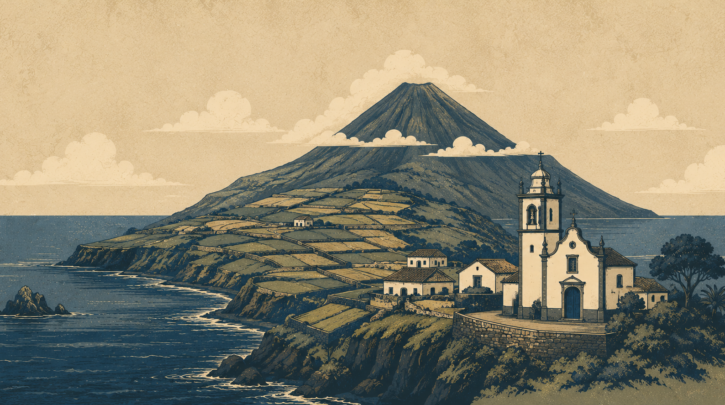

For a great many people with Portuguese ancestry—especially Portuguese-Americans and Portuguese-Canadians—the family did not come from the mainland at all, but from the Atlantic islands of the Azores or Madeira. Island research has its own character: its own archives, its own emigration story, and often wonderfully complete records. If your roots are in the islands, this guide will orient you—and the first, crucial step is simply recognising that your research belongs here rather than on the mainland.
Not sure where to start with your Portuguese ancestry?
Get the Portuguese Genealogy Quick-Start Checklist — a 5-step path to your first real ancestor record, plus the two-surname naming system that trips up almost every beginner.
Why so many diaspora roots are in the islands
The Azores and Madeira, though small, sent emigrants abroad in numbers out of all proportion to their population. Island life was hard—limited land, periodic hardship, and the pull of opportunity across the Atlantic—and from the nineteenth century (and earlier) Azoreans and Madeirans left in great waves, especially for the United States (New England, California and Hawaii) and Canada. As a result, a large share of the Portuguese diaspora is specifically island in origin, and many families who simply know they are “Portuguese” are in fact Azorean or Madeiran. We tell the emigration story in Azorean and Madeiran emigration.
The islands’ own archives
The key practical point is that the islands have their own regional archives, separate from the mainland district archives. The Azores, spread across nine islands in three groups, are served by regional public archives (historically centred on Ponta Delgada, Angra do Heroísmo and Horta, for the three island groups), while Madeira has its own regional archive. These hold the parish registers and civil records of the islands, and several offer good online access to digitised images—so island records can often be researched from anywhere.
Island roots mean island archives—and much is digitised and free. Check FamilySearch and the regional archives together, all on the records hub.
Island records and their strengths
Island records are often a pleasure to work with. Because the islands were relatively contained communities, their parish registers can be quite complete, and—like Portuguese records generally—nineteenth-century island baptisms frequently name grandparents and origins, letting you trace island families back through the generations. The relatively closed nature of island populations means families intermarried within the islands, which both helps (a family stays traceable in one place) and challenges (many people share names and are related in complex ways) the researcher—a pattern echoed in the islands’ distinctive DNA.
Emigration records for islanders
For island families, the emigration records are especially valuable. Passport registers and departure records document the great outflow to the Americas and can link an emigrant abroad directly to their island parish, while the strong festa and community associations that Azorean and Madeiran emigrants founded abroad often preserved ties to specific home villages. Combined with the records the emigrant generated in the new country, these can bridge the ocean and lead you back to the exact island parish—the essential connection explored in finding your emigrant ancestor.
Getting oriented for island research
If your family is from the islands, begin by pinning down which island and which parish—since the Azores in particular spread across nine distinct islands, each with its own communities and records. Family tradition, emigration records, and the origins named in records abroad usually get you there. Then turn to the appropriate regional archive and to FamilySearch, which between them hold most island records, much of it free and online. Island genealogy is among the most rewarding branches of Portuguese research—the records are often rich, the communities well documented, and the connection between the diaspora and a specific island village unusually strong and recoverable.
Which island, and island-hopping ancestors
Because the Azores stretch across nine islands in three widely separated groups, and Madeira sits hundreds of miles to the south, island research begins with pinning down exactly which island your family came from—not merely “the Azores.” The islands differ in their communities, their records and their emigration patterns, and confusing one for another wastes effort. Family tradition, the origins named in records abroad, and emigration documents usually identify the island, after which the specific parish can be sought in that island’s registers. Getting the island right is the island equivalent of finding the mainland parish: the orientation on which everything else depends.
Be aware, too, that island families sometimes moved between islands, or between an island and the mainland, before emigrating—so an ancestor born on one island may appear in the records of another, or of a mainland port. This mobility can complicate a search but is quite traceable once expected, since the ever-helpful Portuguese records name origins (naturalidade) that reveal such moves. Following an island family may therefore mean tracing them across more than one island’s registers, each a distinct body of records with its own regional archive, but each equally rich and, increasingly, available online.