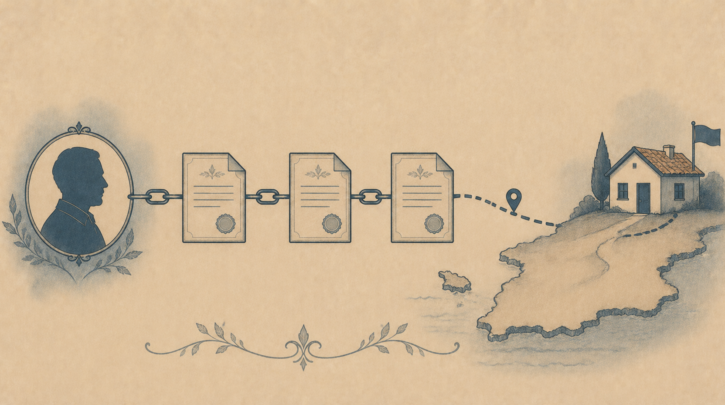

Until recently, Portuguese citizenship by descent effectively stopped at the grandparent: great-grandchildren had no direct route. The 2026 reform changed this, creating a route for the third generation—but with conditions that make it very different from, and far more demanding than, the parent and grandparent routes. Above all, it requires living in Portugal for five years. This guide explains the new great-grandparent route honestly, so you understand both the opportunity and its real limits.
Important: This article is general information for educational purposes, not legal advice. Portuguese nationality law is detailed and changed substantially in 2026, and any individual case depends on its particular facts. Always verify your situation with the Portuguese authorities (the IRN — Instituto dos Registos e do Notariado, and the Conservatória dos Registos Centrais) or a qualified professional before acting.
Not sure where to start with your Portuguese ancestry?
Get the Portuguese Genealogy Quick-Start Checklist — a 5-step path to your first real ancestor record, plus the two-surname naming system that trips up almost every beginner.
A genuinely new route
The reform of 2026 (Organic Law 1/2026) extended citizenship by descent to great-grandchildren (the third generation) for the first time, filling a gap that had previously left many with Portuguese great-grandparents no direct descent option. This is a real expansion, and for some it opens a door that was firmly shut before. But it comes wrapped in conditions that reflect Portugal’s wish that third-generation citizens have a genuine, lived connection to the country—conditions that fundamentally shape who the route can actually serve.
The residence requirement changes everything
The decisive condition is five years of legal residence in Portugal. Unlike the parent and grandparent routes, which can be pursued from abroad without ever living in Portugal, the great-grandparent route requires you to actually move to and reside in Portugal for a substantial period. This transforms it from a documentary claim into a genuine relocation and settlement—a major life undertaking, not a remote, do-it-yourself application. For the great majority of diaspora descendants hoping to claim from their home country, this requirement puts the great-grandparent route effectively out of reach unless they are prepared to emigrate to Portugal.
The higher language requirement
The route also raises the language bar. Where the grandparent route accepts basic A2 Portuguese, the great-grandparent route requires an intermediate B1 level—a meaningfully higher standard, reflecting the deeper connection expected of a third-generation claimant. Combined with the residence requirement, the B1 language level underscores that this route is designed for those genuinely integrating into Portuguese life, not for remote applicants seeking a passport on the strength of a distant ancestor alone.
Proof of a genuine connection
Beyond residence and language, the route requires proof of an effective connection to the Portuguese community—a genuine, demonstrable link to Portugal and its culture. Together with the years of residence and the intermediate language, this connection requirement makes clear the route’s underlying logic: Portugal is willing to recognise third-generation descendants as citizens, but only where they have made a real commitment to, and integration into, the country—not on descent alone.
Who the route actually suits
Realistically, the great-grandparent route suits a specific kind of person: someone with a Portuguese great-grandparent who genuinely wishes to live in Portugal. For such a person—perhaps a descendant drawn to relocate to the land of their ancestors—the route offers a path to citizenship that rewards their commitment. For the far larger number who hope to claim from abroad without moving, the route does not, in practice, provide a remote option, and the honest conclusion is that it will not help them. Recognising this saves the disappointment of pursuing a route whose central requirement cannot be met from afar.
Alternatives to consider
If you have a Portuguese great-grandparent but cannot relocate to Portugal, it is worth checking whether a closer ancestor also qualifies—sometimes a claim can be built through a grandparent whose own status opens the more accessible grandparent route, especially where citizenship was retained down the generations. It is also worth remembering that heritage does not require a passport—the family history, the culture and the connection to Portugal are all yours to reclaim regardless. But where relocation is possible and desired, the new route is a genuine and welcome addition.
An honest assessment
The great-grandparent route is a real expansion of Portuguese citizenship by descent, and for those willing and able to live in Portugal it is a valuable opportunity. But its five-year residence requirement means it is emphatically not the remote, ancestry-only route that the parent and grandparent paths provide, and much online commentary that presents it as an easy third-generation option is misleading. Approach it with clear eyes: if you intend to make a life in Portugal, it may be for you; if you hope to claim from abroad, focus your energy on a closer-ancestor route if one exists, and verify your options with the Portuguese authorities or a qualified adviser.