
If your roots are in the Azores or Madeira—as those of a great many Portuguese-Americans and Portuguese-Canadians are—your DNA results may behave in distinctive ways that puzzle the unprepared. Island populations, settled by relatively small founding groups and somewhat isolated for generations, show genetic patterns—endogamy and founder effects—that can inflate your match list and make relationships look closer than they are. Understanding this is essential to reading island DNA correctly. This guide explains Azorean and Madeiran DNA and how to interpret it.
Founder effects and island settlement
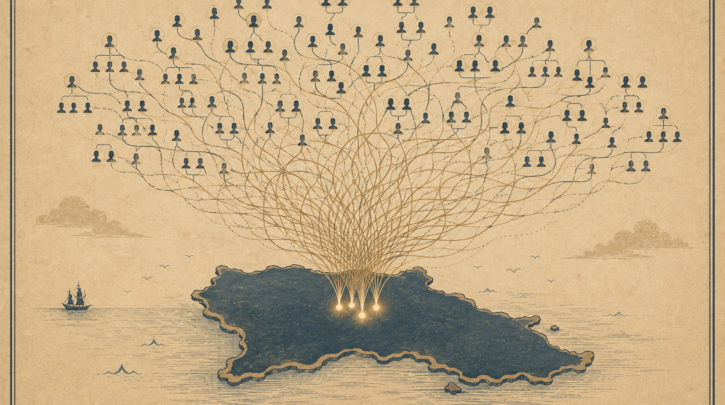
The Azores and Madeira were uninhabited when the Portuguese settled them in the fifteenth century, populated by relatively small founding groups that then grew somewhat in isolation. This history produces what geneticists call founder effects: the descendants of a limited founding population share a great deal of common ancestry, so certain lineages and genetic variants are concentrated in the island populations. For the genealogist, the key consequence is that island descendants tend to be related to one another in multiple ways, through many shared ancestral lines rather than one—a pattern with real effects on DNA results.
Not sure where to start with your Portuguese ancestry?
Get the Portuguese Genealogy Quick-Start Checklist — a 5-step path to your first real ancestor record, plus the two-surname naming system that trips up almost every beginner.
Endogamy and its effects
Because island populations were relatively closed, people married within the islands over many generations—endogamy—which, combined with the founder effects, means island families often descend from the same ancestors along several different lines. This is the opposite of an outbred population, and it has two practical effects on your DNA. First, you will likely have many more matches than a non-endogamous person, because you share DNA with a large, interrelated island-descended community. Second, those matches will often share more DNA with you than their true relationship would suggest, because you connect through multiple lines at once.
Inflated closeness: pedigree collapse
The crucial pitfall to understand is that island endogamy makes relationships look closer than they are. When you and a match descend from common island ancestors along several lines—a phenomenon related to “pedigree collapse,” where the same ancestors occupy multiple positions in a family tree—the total DNA you share is boosted, so the testing company’s predicted relationship may be too close. A match flagged as, say, a second cousin might in reality be a more distant relative who connects to you through several island lines. Reading island matches at face value, without allowing for this inflation, is the single most common error in Azorean and Madeiran DNA work.
How to interpret island DNA
The remedy is to interpret island DNA with the endogamy in mind. Treat predicted relationships as likely too close, and lean harder on the documentary records to establish the actual connection, rather than trusting the centimorgan total. Look for matches who connect through a specific, documentable line rather than the general island-descended background. And use tools like a chromosome browser where helpful. Island DNA is genuinely valuable—it can connect you to a tight, well-documented island community and help pinpoint your island parish—but only when read with an understanding of how endogamy distorts the raw numbers.
The Sephardic and converso question
Island descendants sometimes wonder about Sephardic (Jewish) ancestry, and there is a historical basis for the question: New Christians (converts and their descendants) were among the settlers of the islands, so converso ancestry exists in island populations, and a small Sephardic DNA trace may appear in results. As with Portuguese DNA generally, however, such a trace is typically small and old, cannot prove specific Sephardic descent, and—crucially—offers no citizenship route, since the Sephardic route has closed. Treat it as a hint about deep island ancestry, worth exploring in the records, not as documentation.
DNA does not establish citizenship
A point island descendants especially should note: DNA—whether it shows island ancestry, a Sephardic trace, or anything else—carries no weight for Portuguese citizenship. A claim through a parent or grandparent rests on a documented chain of births and citizenship status, not on a match list or an ethnicity estimate. DNA can help you find relatives and identify your island parish; it proves nothing for citizenship. This is informational only and not legal advice; verify any citizenship question with the Portuguese authorities.
The reward of island DNA
Handled with understanding, island DNA is a rich resource. The very endogamy that complicates the numbers also means island-descended communities are tightly interconnected and often well documented, so a cluster of island matches—read carefully and confirmed in the island records—can help you identify exactly which island and parish your family came from, and connect you to a warm, rooted diaspora community. Read your island matches with due caution about inflated closeness, anchor every connection in the documents, and Azorean and Madeiran DNA becomes one of the most rewarding parts of island genealogy—a genetic thread back to a specific village in the Atlantic.