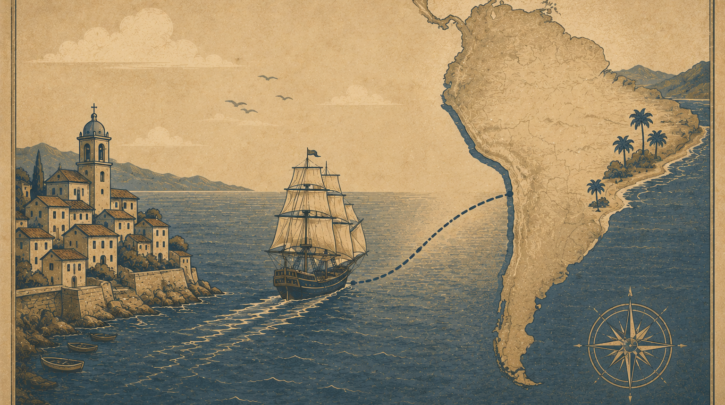

Of all the destinations of the Portuguese diaspora, none compares to Brazil. From the colonial era into the twentieth century, Portuguese emigrants went to Brazil in numbers that dwarf every other destination, drawn by a shared language, deep colonial ties, and vast opportunity. If your Portuguese ancestor emigrated, there is a strong chance they went not to North America but to Brazil—and their story is one of the great chapters of the Portuguese diaspora. This guide traces it and shows how to research a Portuguese-Brazilian family.
The colonial foundation
The Portuguese connection to Brazil began with colonisation. Brazil was Portugal’s colony from 1500 until independence in 1822, and over those three centuries Portuguese settlers, officials, merchants and colonists crossed the Atlantic to build and govern the colony. This long colonial era planted deep Portuguese roots in Brazil—in its language, culture, institutions and population—and created the foundation of familiarity and connection on which all later emigration would build. Many Portuguese-Brazilian families trace their origins to this colonial settlement.
Not sure where to start with your Portuguese ancestry?
Get the Portuguese Genealogy Quick-Start Checklist — a 5-step path to your first real ancestor record, plus the two-surname naming system that trips up almost every beginner.
The great waves of the 19th and 20th centuries
Emigration to Brazil did not end with independence—it accelerated. Through the nineteenth and into the twentieth century, Portuguese emigrated to Brazil in enormous, sustained waves, making Brazil the overwhelming primary destination of the Portuguese diaspora. They came from all over Portugal—the mainland north especially, but also the islands—seeking the opportunity that a booming, Portuguese-speaking nation offered. This modern emigration, layered atop the colonial foundation, built the immense Portuguese-descended population that Brazil carries today.
Why Brazil drew the Portuguese
Several forces made Brazil the natural destination. Most obviously, there was no language barrier—Portuguese emigrants arrived speaking the national language, an advantage no other major destination offered. There were established Portuguese communities and deep cultural familiarity from the colonial centuries. Brazil’s expanding economy—its cities, commerce and agriculture—offered wide opportunity. And the sheer historical closeness of the two nations made Brazil feel less foreign than anywhere else. For a Portuguese emigrant, Brazil combined opportunity with familiarity in a way that made it the obvious choice.
Where emigrants settled
Portuguese emigrants settled across Brazil, but especially in its great cities and economic centres—Rio de Janeiro, São Paulo and the growing urban and commercial hubs where opportunity concentrated. Many entered commerce and trade; others worked in the cities or on the land. The Portuguese became a substantial and influential presence in Brazilian urban life, and their communities—while assimilating readily into a Portuguese-speaking society—maintained connections of family and origin back to Portugal, connections that the genealogist can often recover.
Researching a Portuguese-Brazilian family
Tracing a family that emigrated to Brazil follows the familiar path but across a Portuguese-speaking divide. You work back through Brazilian records—civil registration, church records, immigration and naturalisation records—to identify the immigrant and, ideally, their Portuguese origin, then cross to the Portuguese records to continue. The shared language is a real help, and Brazilian records—many increasingly digitised—can be rich. The key, as always, is to find the immigrant’s naturalidade: the Portuguese parish or island of origin that unlocks the deep records back home.
The enduring Portugal-Brazil connection
The bond between Portugal and Brazil remains uniquely close, and this helps the researcher. The two nations share the language, and Brazil is part of the CPLP (the community of Portuguese-speaking countries), a relationship that even carries into citizenship matters. Portuguese-Brazilian families often retained strong awareness of their origins, and the vast scholarship and records on Portuguese emigration to Brazil—on both sides of the Atlantic—give the researcher much to work with. For descendants, understanding this deep connection is the context for a family history that spans the Portuguese-speaking world.
Brazil and Portuguese citizenship
For Portuguese-Brazilian descendants, one modern point is especially significant: a Brazilian who qualifies through a Portuguese parent or grandparent may claim Portuguese—and therefore EU—citizenship, and Portugal permits dual nationality, so no renunciation of Brazilian citizenship is required. This makes tracing a Portuguese-Brazilian line potentially life-changing, not merely a matter of family history. Whether or not citizenship is your goal, the immense Portuguese emigration to Brazil is the largest and most important stream of the whole diaspora—and recovering your family’s place in it connects you to the deepest current of the Portuguese story abroad.