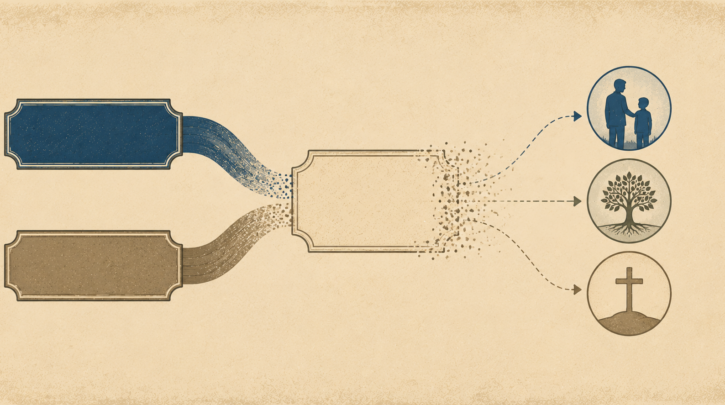

Portuguese surnames are rich in history and meaning—patronymics that name a distant ancestor, names drawn from the trees and rivers of the homeland, and devotional names that speak of faith, or sometimes of a foundling child or a convert family. But Portuguese surnames also work differently from those of many countries: they come in twos, they were historically fluid, and they tell you less about a fixed lineage than you might expect. This guide explains where Portuguese surnames come from, what the main types mean, and what yours may reveal.
The two-surname system
The first thing to understand is that Portuguese naming gives a person a given name followed by two or more surnames—conventionally the mother’s surname(s) first and the father’s last, so the final surname is usually the principal, paternal one. This system, and its historical variability, is explored for research purposes in our guide to Portuguese naming conventions. For understanding origins, the key point is that each of a person’s surnames has its own history and type—so a single Portuguese name may combine, say, a patronymic and a place name, each with a different story to tell.
Patronymic surnames: the -es names
A great many Portuguese surnames are patronymics—names formed from a father’s given name, ending in the distinctive Portuguese suffix -es, meaning “son of.” Fernandes means “son of Fernão,” Rodrigues “son of Rodrigo,” Gonçalves “son of Gonçalo.” Among the most common of all Portuguese surnames, these began as true patronymics that changed each generation before freezing into hereditary names in the medieval period; we explore them in Portuguese patronymic surnames.
Place and nature names
Perhaps the largest category of all is the toponymic—surnames drawn from places and, especially, from nature: trees, water and terrain. Silva (woodland), Pereira (pear tree), Oliveira (olive tree), Costa (coast), Carvalho (oak) are among the most common Portuguese surnames, and all describe the natural world of the homeland. We explore this rich category in Portuguese place and nature surnames—names that sometimes even hint at a family’s place of origin.
Religious and devotional names
Distinctively Portuguese are the religious surnames—dos Santos (“of the saints”), de Jesus, da Conceição, da Cruz—names of piety and devotion. These are among the most common Portuguese surnames, but they carry a fascinating complexity: a religious surname can reflect simple devotion, or it can point to a foundling ancestor, or to convert (New Christian) ancestry. We treat them honestly in Portuguese religious surnames.
Occupational and descriptive names
Smaller categories round out the picture. Some Portuguese surnames are occupational, from a trade or role—Monteiro (huntsman/gamekeeper), Ferreira (associated with ironworking, though often toponymic in origin)—and a few are descriptive, from a personal characteristic, such as Branco (white/fair). These are less prominent in Portuguese than in some other naming traditions, where the patronymic, toponymic and religious categories dominate, but they add further variety to the tapestry of Portuguese names.
What your surname does—and doesn’t—tell you
Here is the crucial honest point. Because Portuguese surnames were historically variable—a person might carry names from a grandparent or godparent, siblings might differ, women’s names varied—a surname tells you less about a fixed lineage than in cultures where names passed rigidly from father to child. Your surname reveals its type and meaning, and sometimes a real clue (a place of origin, a possible foundling or convert ancestry), but it does not by itself prove descent from any particular family. That is a matter for the records.
Surnames and your research
Understanding your surname’s type is nonetheless a genuine research aid. A toponymic name may point to a place to investigate; a religious name may prompt you to consider foundling or convert ancestry; a patronymic names an ancestor’s given name. But because Portuguese names shift, you must always confirm the actual family in the records, matching people by parents, godparents, origins and dates rather than by surname—the method set out in researching your Portuguese surname. Decode the name for its meaning; prove the family in the documents.
A name worth understanding
Your Portuguese surname—or, more often, your two or more surnames—connects you to the deep history of Portugal: to a medieval ancestor named in a patronymic, to the woods and rivers of a home region, to the faith that shaped Portuguese life, perhaps to a poignant story of a foundling or a convert family. Understanding what your names mean and where they come from is a rewarding part of the genealogical journey—and the first step toward tracing, in the records, the real people who first bore them. Explore each type in the guides that follow, and then learn to research your own name in the Portuguese records.